
The fundamentals of golf course routing
| Golf Course Design, Robin Hiseman
Estimated reading time 7 min

Pete Dye did one for French Lick. On a napkin. They put it in a display case for all to see. I’ve done one on a scorecard. I was delighted with it, so showed it to the prospective client…and they gave me the commission. Mostly, I’ll use a sheet of tracing paper, sized according to how big the job is.
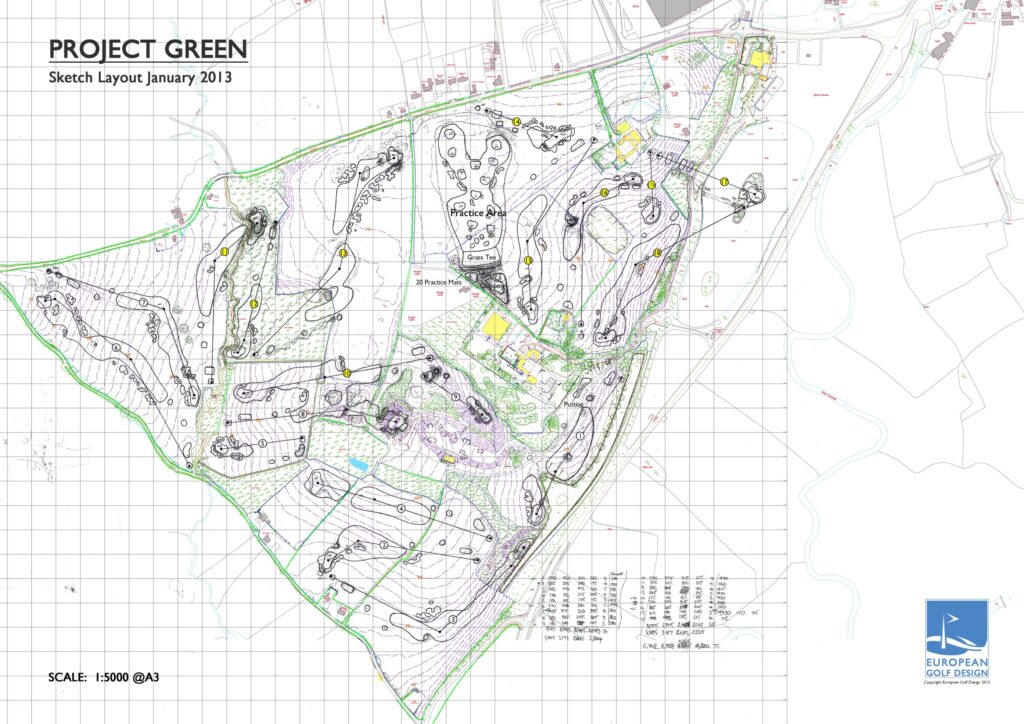
A golf course routing plan often starts with a humble drawing and in French Lick’s case, the napkin sketch was the only time pen was put to paper for what became the Pete Dye Course. Whilst the golf course design process may start with a quick scribble, the thinking behind it, or lack of, can directly influence the cost, functionality and sustainability of the entire project to the tune of millions and make the difference between a design being a world-beater or a dead duck.
What is golf course routing?
Golf course routing is the process of planning how the 18 holes of a golf course move across the landscape, determining the sequence of holes, their direction of play and how the design works with the natural terrain.
The importance of golf course routing
The ability to read a site plan and to lay out a functional golf course routing is one of the main skills that sets apart an experienced golf course architect from the layman. It is amazing how illogical and functionally illiterate a poorly conceived routing plan can be. I recall one such experience, where I went to a new golf course to help the owner solve a serious problem with his homemade design. The site was split in two by a deep, steep-sided dry valley full of bushes and trees. A dramatic feature, which he sought to optimise by playing over at right angles repeatedly. When the course opened it was quickly realised that most players could not hit it far enough to carry over the canyon, thus rendering the course unplayable. It had to be hastily redesigned, eradicating all the dramatic shots over the wide ravine. Had they engaged an experienced golf course architect from the outset, this embarrassing mistake would have been avoided.
Reading the landscape
Occasionally, European Golf Design invite budding golf course architects to our office for work experience. Usually, they will be given a layout planning task, using a survey plan from a real project. This gives us an idea of their base capability level when it comes to ‘reading’ a site. Sometimes, we quickly see that they don’t have an eye for it. Others have had the knack and have gone on to forge successful design careers. In one case they were employed by EGD.
Each project site is unique, but tropes exist to inform the site analysis process. For instance, if we have topographic mapping, we can gauge the severity of the site slopes and design accordingly. On flat sites, we look for areas where the contours are close together, as it signifies naturally more interesting terrain, whilst conversely, on steep sites, we look for areas where the contouring is more widely spaced, as it offers natural ledges and platforms that will be easier and more economical to work with and might be suitable for tee and green sites.
Working with the topography
The key is to work with the topography, rather than fight against it, as this reduces development costs and produces a more natural outcome. Consider the example of a hole playing up a hill to a summit and then down the other side to a green, which is a common scenario on rolling terrain. Do you A; position the tee as far back as it can go to maximise length, but create the problem that most golfers won’t hit it far enough to reach the summit and see the green for their second shot, or B; sacrifice length and let the golfer hit over the summit with ease for a clear view of the green, or C; bulldoze away the top of the hill to create a situation with neither a blind drive or second shot. Option A is always the wrong thing to do if the choice to do B exists, but C is the outcome one will often see imposed on modern developments at significant cost. Of course, the experienced golf architect will also look for a routing that avoids such an issue in the first place.
Finding natural golf holes
The perfect layout, if such a thing exists, will wander around a site in much the same way as you might be inclined to explore it on foot. It should feel intuitive and natural. Often a site will give you a few locations where the trained eye can see the potential for a golf hole. It might be a tee or green site, or even a complete hole. At JCB, I ‘found’ what became the 11th hole straightaway, thinking it was a lovely, natural hole, with a pretty setting, framed by an old oak tree and a winding brook. That one hole influenced how the rest of the layout was planned, as it gave me a target to reach with the holes that preceded it and a starting point for those that followed. If a site gives you a few of these helpful prompts, the remainder of the layout planning becomes a case of joining the dots. Sometimes, you will find a stunning hole location that cannot be linked up with the rest of the layout, no matter how hard you try. Always a bit of a downer when that happens.

How routing influences the entire project
The decisions made about a course routing influence far more than just the golfing experience. We will be thinking from the outset about how we will build the holes on the plan. Can we limit the amount of costly earthworks? Can we ensure a cut and fill earthworks balance? Not just across the entire site, but within localised pockets to save time and transportation costs. We will try to avoid rocky areas with fairways or boggy areas that need draining. The layout plan affects so much. We will think about the clubhouse location, the size and solar orientation of the land-greedy practice area. Are we able to arrange it in two loops of nine, or does the site dictate an out-and-back routing. Will we be able to harvest drainage water and feed it to an irrigation lake, so helping costs and sustainability? Where will the maintenance building be and can we make it both discrete, but with easy access to the course extremities?
The foundation of golf course design
It all starts with that first hand-drawn sketch. The layman often thinks the golf course routing plan is the sum of the golf course architect’s design input, but it is merely the overture of a complex symphony. Get the layout right and what follows becomes much simpler and more resilient. Get it wrong and the course lives with those limitations indefinitely. The routing is a critical aspect of the entire design process.
First published on: European Golf Design Golf Course Routing: How Golf Course Architects Plan a Course Layout