
Why 18 Holes?
| News
Estimated reading time 7 min
<1R>
The Idea
We need to abandon the principle that a ‘full’ round of golf consists of eighteen holes and get used to the thought that a golf course may have just any number of holes that suits its particular environment. This will help many struggling golf clubs make quick and relatively easy changes to adapt to the needs of today’s golfer, allow them to co-exist with other existing courses that wish to stick to their current model, open new dimensions in the design of new courses and give golf greater flexibility to work hand in hand with the environment.
The Problem: Time & Money
Time
Most of us know all too well that a game of golf is taking too long these days. Who has not experienced five and six hour rounds?
Surely, the working men and women of today can not spare that much time on the golf course. The key for the golf industry is to get golf back to being an experience of, say, 3 hours plus – the way it once was. This is a time unit that could work for the way we live today – not too short but long enough to achieve fulfillment.
Money
To make the game more affordable, we must find ways to lower construction and running costs. The more we are able to lower this cost, we can offer the player lower fees. It is easy to predict that by each decade from now on, dealing with environmental restrictions will not become any easier for golf clubs than it is today. If anything, this and other tasks will become more complicated and more expensive. It will take a major breakthrough of historical proportions to change the outlook and alter this reality.
Golf will therefore not become any less expensive in the coming decades unless we are ready to open our minds to what golf really is, from what it has originated and how it has evolved for the several hundred years it has been played.
Why We Play 18 Holes
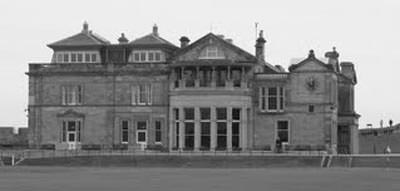 ‘If you accept that the Old Course at St. Andrews is The original course (and there is precious little argument), then all courses created since are to some degree copies. We build in good faith, courses of 18 holes (and not 15 or 20) in emulation of the original. We build sand bunkers in the mountains of Japan or in the swamps of Florida only because we are trying to copy the Old Course and its features.’
– Peter Thomson, Hazards
Little needs to be added to the words of five time Open Champion Peter Thomson. Still, it is important to recognize why the Old Course has eighteen holes, and not 15 or 20. The Old Course originally had 22 holes, ten of which were played twice – once in each direction – first on the outward journey and again going back towards the town. The 11th and 22nd holes were only used once during each round.
In 1764, The Royal and Ancient Golf Club of St. Andrews reduced the number of holes to eighteen. This later became a standard because the Royal and Ancient Golf Club became a leading authority after more or less defeating The Honorable Company of Edinburgh Golfers at Musselburgh in a power struggle. Musselburgh had seven holes, and this could easily have become a standard had the club prevailed in the battle against The R&A.
But I think we have not fully understood the message that is involved in the R&A’s decision from 1764. Here are the minutes of this significant meeting:
‘The captain and gentlemen golfers are of the opinion that it would be for the improvement of the links that the first four holes should be converted into two. They have therefore agreed that for the future they shall be played as two holes in the same way as presently marked out.’
Note the words: “for the improvement of the links”. The holes eliminated were the first and last holes of the course. They occupied the area now known as The Scores behind the R&A clubhouse. For those who have been to St. Andrews, this is the place where you will now find the Martyrs’ Monument. It is easy to see that this area is of much lesser quality to that of the remaining eighteen holes on The Old Course.
After this change – and the gradual strengthening of the R&A’s status as an influential body in the game – other clubs soon followed the Old Course model. Still, this did not occur until the 1870’s and 80’s. Until then, there were many courses all over Scotland that had a different number of holes. The Open Championship (British Open) started in 1860 on a twelve hole course in Prestwick. Allan Robertson, the professional and ballmaker at St. Andrews, once laid out a 10 hole course in Barry. Montrose once had 25 holes. There are many more examples.
Long learning curve
It is interesting that it still took more than a century for this trend to take shape, almost the same amount of time that has now passed since eighteen holes became the norm. It is easy to be get stuck in the status quo, but if we try to think in centuries instead of decades, it does not sound so unlikely that two hundred years from now, people will look at these last 120-130 years as a mere learning curve for the golf industry.
We have followed the eighteen hole standard now for roughly 120 years. We still do it, even though I am sure we can all agree that today’s parameters are vastly different from those that applied to the game in 1764 or in 1890, when Tom Morris laid out two outstanding eighteen hole courses: Muirfield in Scotland and County Down in Northern Ireland.
The R&A’s decision in 1764 is perhaps the most significant single decision that has been made in the history of golf so far. But what is its true message? Can it not be understood that the number of holes on a golf course should simply be dictated by the nature of the terrain, how much land is available and how the holes may be reasonably arranged to form the most pleasurable layout? Will it really take us more than a quarter of a millennium to figure this out?
Try asking yourself this: Do you think that those who attended this meeting in St. Andrews in 1764 ever considered or expected that 250 years later, people would still be investing a great deal of effort and money to produce courses with the same number of holes – no matter what – even if the available land did not really suggest it? Do you think this is what they were trying to establish?
Why Not 12 Holes?
It is important to note that the idea of 12 holes becoming the new standard has been voiced several times. While this would of course help solve the time issue, I still consider this solution incomplete. For example, adapting to a new fixed standard will be both costly and complicated for most existing courses. There is a very good chance that they would not be able to find a chain of 12 holes that both has a start and finish at the clubhouse without going through possibly expensive alterations. They may also get in a situation where some of the most cherished holes would need to be abandoned for a twelve hole layout to function properly. Also, the other six holes may also end up totally detached and ill suited as an alternative facility of some sort.
I would consider it an opportunity lost if we were to go through this seemingly insurmountable mental hurdle of abandoning the eighteen hole principle by jumping straight to a new standard – a new fixed number – instead of simply opening our minds to the fact that a golf course is of no lesser status if it has some other number of holes, based entirely on local conditions.
This article has been taken from Edwin’s website www.why18holes.com