
Golf architecture, a real art
| News
Estimated reading time 7 min
As a professional golfer, a tournament promoter and a television golf commentator, and in no way a golf course architect, I am not sure if I am qualified to discuss golf architecture. But answering the demand of EIGCA, here are a few thoughts inspired by more than 30 years of life in, by and for the game of golf. I just hope these will be of some use to the debate opened in this publication about the conception of courses and the very nature of the game itself.
 It seems to-day to be “golfically correct”, if I may say so, to advocate the new against the old, although in terms of golf architecture we have invented nothing new. It is true that golf courses are easier for professionals and in many events on the US and European Tours the preferred lies local rule is used against the very spirit of the game. Every week we see modern courses being severely beaten by the best pros while amateurs find the same courses unplayable. We live upside down and the game ceases to be an “art de vivre”, turned into an exercise of hard work deprived of imagination, more and more standardized and almost industrial.
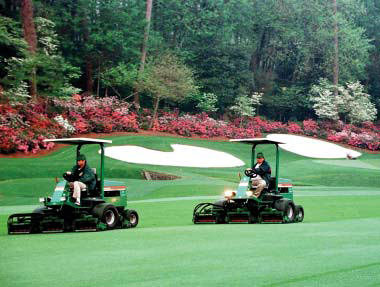
Today’s conception of the game and the courses is based on the target golf theory. The game has become simple, if not simplistic: with good standard equipment, a swing done a thousand times on the practice ground (such practice was totally unknown for old time British golfers), you only need to choose the right club (the one which corresponds to the distance, not to any inventive shot) and to reproduce the well-learned movement. Such a standardization in the art of playing golf is adapted to modern courses: wide and flat bunkers (saving irrigation and care), many water hazards (the Venice syndrome facilitates the management of water on site) unless it was created by them. This modern conception is evidently linked to technical factors such as the use of mechanical mowers and other machines, selective chemicals, a more and more sophisticated management of irrigation systems. It has thrown the game into the economic world and golf is becoming more and more expensive for everybody, although there are more simple methods of constructing and exploiting golf courses.
Finally, starting from a sheep mowed and dune sided land we are now facing an entirely artificial reconstruction implying the digging of ground, the movement of thousands of tons of earth, the construction of complex irrigation systems and the plantation of trees and plants totally unknown in the original natural location. In itself, this costly recreation is in no way to be condemned for the reason that it brings to the new and numerous users the same kind of pleasure as the one experienced by the old Scottish shepherds. Misunderstood, poorly controlled, that evolution can lead to the sheer destruction of the spirit of the game, whatever their best intentions. If we want to ensure that such an evolution does not occur, we, the actors on the scene of golf, have to explain how it operates.
From this point of view the role of the professional golfers is crucial. They are an example as players as well as teachers. The transmission of the golf culture is made through them and this is one of my fears. The old style courses do not please most of the professional golfers, on the US and European Tours. The pros should understand that if they accept to play (shall I say against) Royal St George’s because it is the venue of the Open, they also ought to stand for a wiser conception considering the other courses where they make their living during the rest of the year. The old courses are much more unpredictable, the surprises are more frequent, they ask the players to bring more invention to their shots and, oddly enough, the scores are often higher after four rounds. This is due to the very nature of those courses. Take, for instance, the last Open Championship at Royal St George’s. It was won by only one shot under par after four extraordinary rounds. I agree that the South East Kent weather conditions were difficult for the month of July, but, apart from a reasonable lengthening of the course (around 6 500 meters) and incredibly deep bunkers, the design and general conception of the course has not changed since the opening in 1887 by Dr W. Laidlaw Purves. As on most links courses, the greens are built behind higher dunes which protect the ball against hurling winds, so that the game can go on. Of course, when the ball flies above this natural protection, it is a different story. This conception is shared by most of the great “old style” courses where the Grand Slam tournaments are played: Turnberry, Troon, St Andrews in Great Britain, but also Shinnecock Hills, Pine Valley, Pinehurst (#2), and Beth Page, in the States, among many others.
I believe that the Sam Snead’s, Ben Hogan’s, Seve Ballesteros’s and Greg Norman’s were as incredibly talented as Tiger Woods. Confronted with real courses, they displayed all their talent to defeat them for, in the end, it is the course who judges the golfer and the winner is the one who manages to avoid the traps and tricks of the course and who is able to invent new shots, to think new strategies, to resist hazards, take the measure of nature and its elements (wind, sun, rain). In itself it is a lesson of life which is still a game; I mean the golf we love.
This article first appeared in the Institute’s Yearbook for 2003-2004.